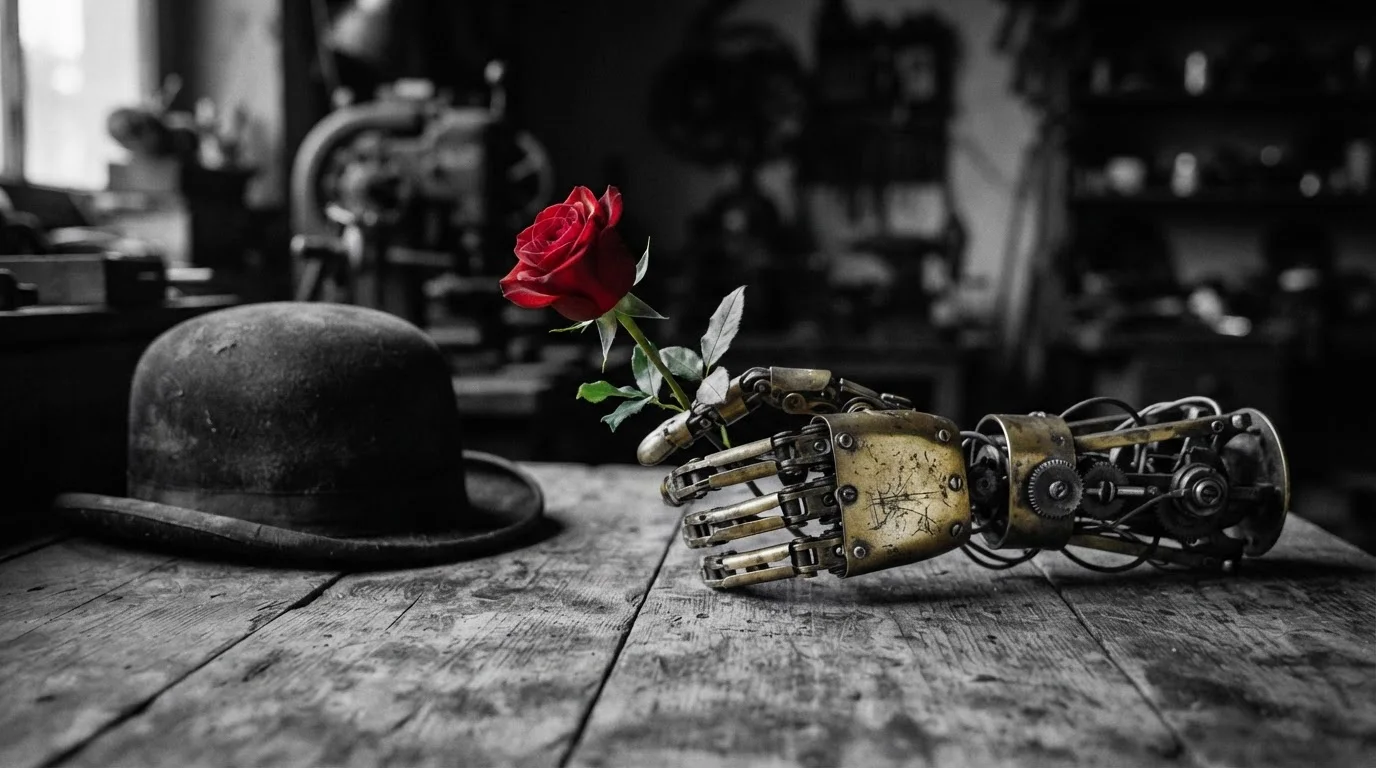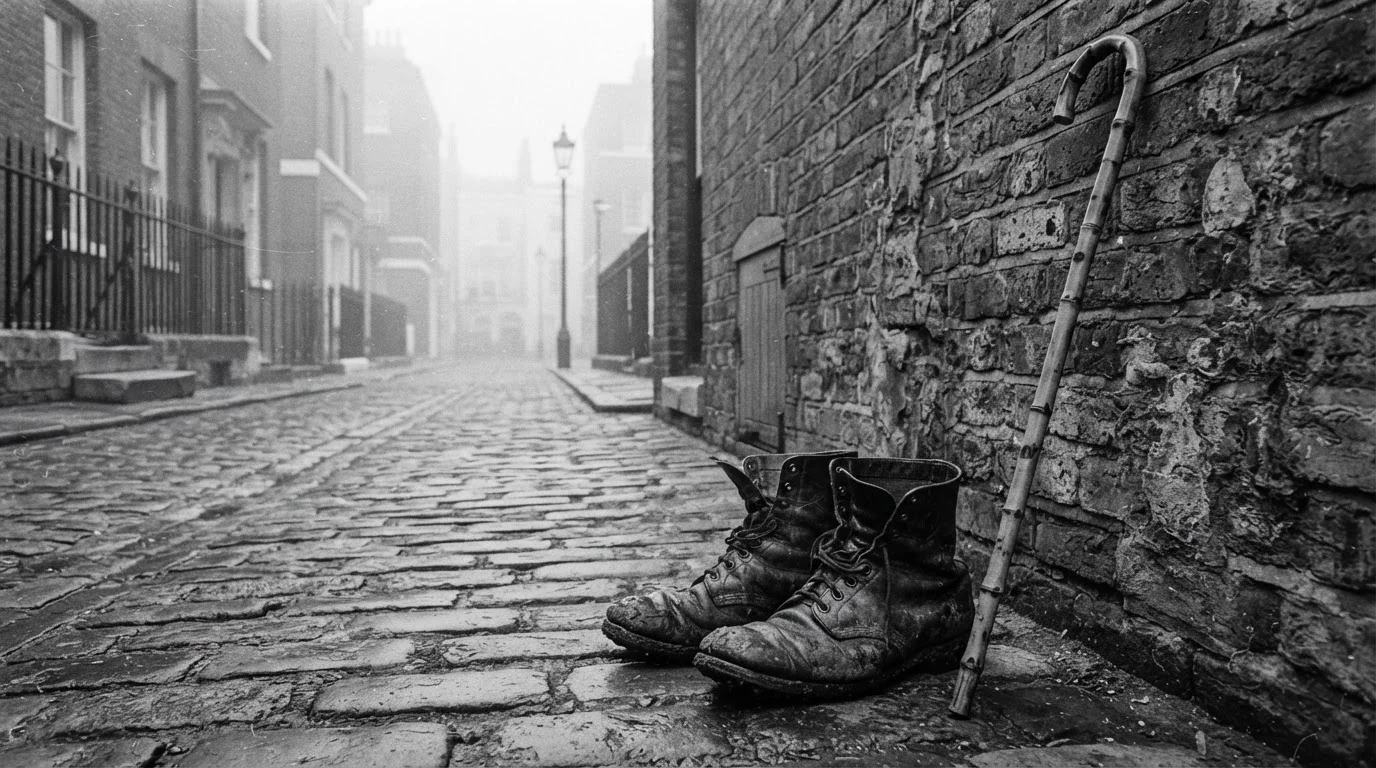

This is a short story. We took Charlie Chaplin's Tramp, set him down in a city of today and followed him for one day. Some of the scenes are inspired by his real films; you'll find where each one comes from at the end.
Morning: the charging station
The Tramp wakes up on a park bench. Instead of a newspaper, he's covered himself with a courier company's advertising poster. He stretches, straightens his hat and finds his cane. From his pocket he pulls a phone with a cracked screen. It's dead.
In the corner of the park there's a free charging station with six people queuing in front of it. The Tramp joins the end of the line, then, when nobody is looking, quietly plugs one of the cables into his phone. The other end of that cable is plugged into the phone of a man in a suit. With the cable stretched between them, every time the man takes a step, the Tramp has to take one too. For a while the two of them walk in perfect rhythm, one tugging the other along. At last the man stops and turns around. The Tramp raises his hat and nods.
Noon: the self-checkout
He's hungry. He walks into a supermarket. There's no cashier, only self-checkout machines. Holding a single sesame bagel, he steps up to one. The machine speaks. The Tramp jumps, looks around, tries to work out who's talking. Then he leans towards the machine and greets it politely.
He tries to scan the bagel. The machine says "unexpected item". He lifts the bagel, puts it back. The machine objects again. This time he lays it down very slowly, like a jeweller setting a diamond. The machine goes quiet and a red light starts flashing. Across the shop, a security guard begins walking towards him. The moment their eyes meet, the Tramp takes a bite of the bagel, glances at the machine, and realises that eating before paying is against the rules. The closer the guard gets, the faster he chews.
Afternoon: the courier
On his way out he spots a notice on the door: "Couriers wanted, start today." An hour later he's out on the street with a huge square box on his back and a rented bicycle underneath him. On his phone there's a map with a blue dot and a countdown that keeps getting shorter.
He can ride a bike, but the box pulls him sideways on every corner. On a hill it catches the wind like a sail and drags him backwards. The countdown turns red. He delivers his first order to the wrong door. The old woman who opens it won't take the order, but she invites him in and gives him a cup of tea. While he's drinking it, his phone buzzes: "Delivery late." He jumps up without putting the glass down, thanks her and runs out still holding it. Halfway down the stairs he notices, comes back and leaves the glass outside her door.
Early evening: the missing star
On his way to the last delivery he sees a little boy sitting on the pavement, staring at the food in a shop window. The Tramp stops. He looks at the bag in his box, then at the boy, then at the countdown on his phone. He sets the bag down beside the boy, pretends he dropped it by accident and walks off whistling.
A little further on his phone buzzes. The customer never got the order and has left a one-star rating. The app tells him his account is "under review". The Tramp stares at the screen for a long time. Then he slips the phone into the inside pocket of his jacket, right over his heart, and pats the pocket twice.
Night: the bus stop
A young woman is waiting at a bus stop. Her phone has died and she has no idea when the bus will come. The Tramp offers her his. The screen is cracked and the battery is at four per cent. She hesitates, then takes it. Meanwhile he tries to look relaxed: he leans on his cane, the cane slips, he recovers and leans on the glass of the shelter instead.
The bus arrives. As she hands the phone back she sees the one-star rating on the screen. She doesn't say anything. Before she gets on, she draws a heart with her finger on his cracked screen. At that exact moment the screen goes black. The battery is gone.
The end
After the bus has gone, the Tramp stays at the stop for a while. He looks at the dark screen, then puts the phone in his pocket. At the end of the street there are rows of parked e-scooters, bright shop windows, people bent over their phones. He straightens his hat, gives his cane a twirl and waddles off down the middle of the road. This time nobody films him.
Where the scenes come from
The cable that ties two men together recalls the way the Tramp falls into the machine's rhythm without meaning to in Modern Times. Talking to the checkout machine comes from The Pawnshop, where he examines a clock as if it were a sick patient. Leaving the food for the boy and walking off whistling echoes the hidden tenderness of The Kid. The bus stop scene is a nod to his brief, unforgettable encounters with the blind flower girl in City Lights. And then there's that final walk: many of the Tramp's stories end with him heading off down the road alone.