 Image generated with AI
Released in 1947, Monsieur Verdoux is the sharpest turn in Charlie Chaplin's career. The Tramp, who for so many years had made the world laugh with his cane, bowler hat and shuffling walk, is nowhere to be found. In his place stands a polite, fastidious gentleman with a fondness for flowers: Henri Verdoux, who marries wealthy widows, disposes of them, and uses their money to support his family. Chaplin sets aside the face his audience loved most and shows them the face of a murderer. And he does it while making them laugh. That is exactly what keeps the film so unsettling, and so brave, to this day.
Stepping Out of the Tramp's Shadow
In The Great Dictator, Chaplin had the Jewish barber, a figure very close to the Tramp, speak directly to the audience in the final scene. In a sense that speech was the Tramp's farewell; the silent vagabond was, for the first time, defending an idea in his own voice. Monsieur Verdoux is the first step after that farewell, and Chaplin takes it in the least expected direction. Verdoux is the Tramp's exact opposite: not poor but elegant, not innocent but calculating, not on the margins of the world but right at its center, a man who knows his business.
What is strange is that Chaplin gives up none of his old skills. The way Verdoux counts banknotes at a bank clerk's speed, his graceful turns in doorways, the way he almost dances from one armchair to another: all of it is body language left over from the silent years. The difference is that this grace now serves a murder plot. Laughing at the familiar virtuosity, the viewer suddenly realizes what they are laughing at and hesitates for a moment. The whole film is built on that hesitation.
Orson Welles's Idea, Chaplin's Film
The film's credits state that the story is based on an idea suggested by Orson Welles. Welles had imagined a film, with Chaplin in the lead, about Henri Désiré Landru, who was tried and executed in France for murdering a number of women. Chaplin was unwilling to act in a film directed by someone else; he took the idea, wrote his own screenplay, and put Welles's name in the credits.
The result is not a true-crime picture but a moral fable. Verdoux is a former bank clerk who lost his job in the Depression. The system he has built for his invalid wife and young son runs with a businessman's composure: different names, different towns, constant train journeys. Chaplin conveys these journeys with recurring shots of spinning train wheels; as the pace quickens, Verdoux's life turns into an assembly line. One can hear a dark echo of the machine in Modern Times here: this time the man is not crushed between the gears but is the one turning them.
Between Laughter and Dread
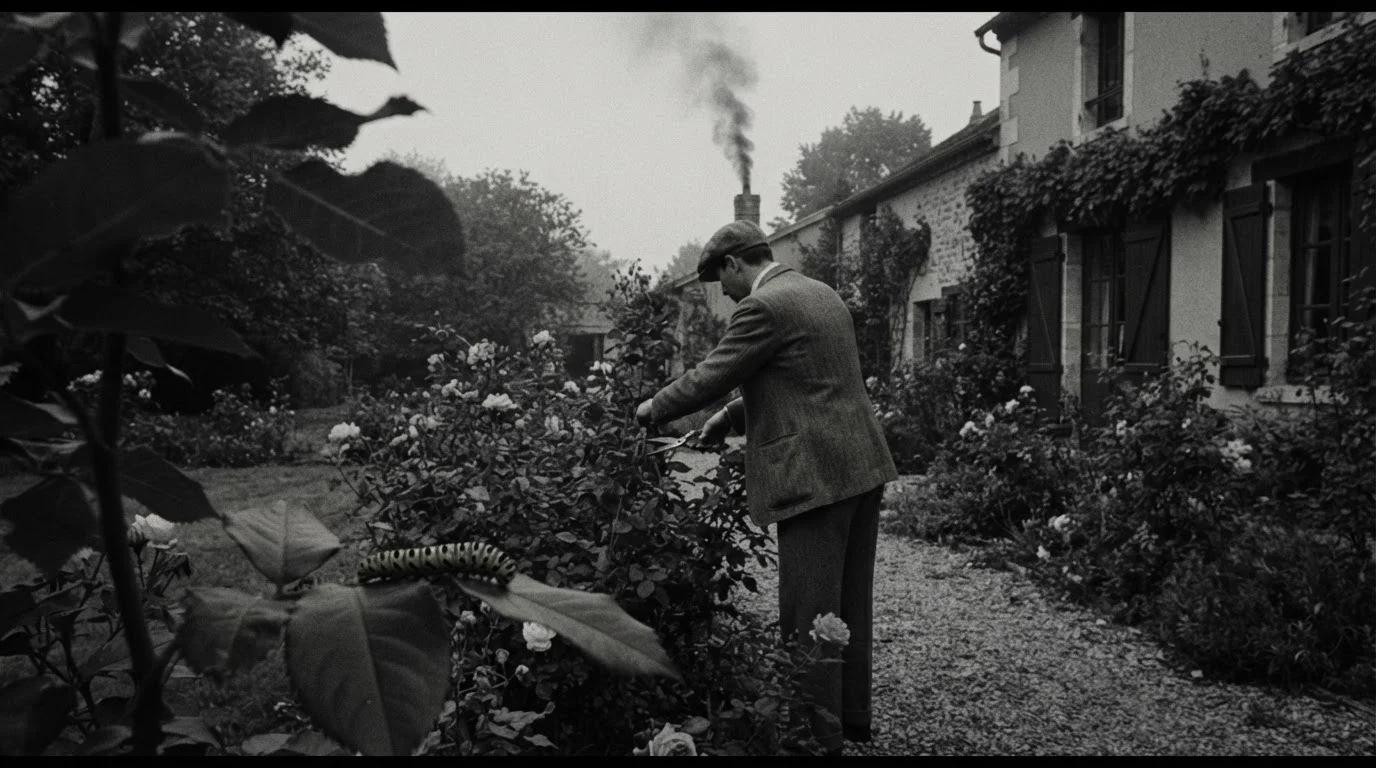
The film opens on Verdoux's gravestone and his voice speaking from beyond. Within the first minutes Chaplin sets out his rules: roses are pruned in a garden, dark smoke rises from a chimney, and Verdoux takes care not to step on a little caterpillar. When we work out what the smoke is, our smile freezes. Black comedy is not an ornament here; it is the film itself.
The funniest sequences are those with Annabella, played by Martha Raye. Loud, lucky and impossible to kill, she unknowingly ruins every one of Verdoux's plans. In the rowing boat scene on the lake, Chaplin's old slapstick mastery returns to the stage; but this time the audience cannot quite tell whether they are laughing at the victim's escape or the killer's clumsiness.
The heart of the film, though, is Verdoux's conversation with the young woman he brings home to test his poison on. Listening to the hardships she has lived through and the faith she keeps in spite of them, Verdoux changes his mind at the last moment. The scene suggests that somewhere inside the killer the Tramp's compassion still lives, and it carries the film to a far sadder place than simple satire.
The Words in Court
Verdoux is eventually caught and put on trial. What he says in court, and afterwards in his cell, explains why the film provoked such a backlash. Verdoux compares his own murders with the mass deaths brought about in wartime with the help of science and industry. In his view, someone who kills one by one is called a monster, while those who do the same on a vast scale are honored with medals. In that comparison he sees himself as an amateur.
The power of these words comes from Chaplin putting them in the mouth not of a hero but of a criminal. Verdoux stays in the mind not because he is right, but because, though he is not right, he puts his finger on an uncomfortable truth. The viewer wants to reject what a man they dislike is saying, but cannot do so easily. The double aim seen throughout Chaplin's cinema, the wish to make people think while making them laugh, reaches its extreme here. Laughter is no longer a consolation; it is almost a form of complicity.
It is not hard to imagine how these words sounded just after the Second World War, in the shadow of the atomic bomb. Chaplin was not excusing a murderer; as Verdoux walks to the guillotine, the film does not make him a hero. But it reminded audiences, harshly, how selectively a society's moral scales operate, and how death turns into an abstract statistic as the scale grows. This was not something the audience, and especially the America of the day, wanted to hear.
A Hostile Reception
Monsieur Verdoux opened in America in an extremely tense climate. The Cold War was about to begin, and Chaplin was a target for part of the press because of his politics, his private life, and the fact that despite living in the country for many years he had never taken American citizenship. He had recently been through a much-publicized paternity case and had been accused of left-wing sympathies. At the press conference held to promote the film, the questions were less about cinema than about his patriotism and political views.
In that atmosphere, a film comparing war with murder was like pouring fuel on a fire. Some groups called for a boycott, some theaters dropped the film, and it failed commercially in America. It was received far more warmly in Europe, especially in France. Despite all the hostility, Chaplin was nominated for the Academy Award for Best Original Screenplay; he did not win, but the nomination showed that the film's artistic weight could not be ignored.
A Belated Reputation
Time has been kinder to Monsieur Verdoux than its first audiences were. In the following decades critics and film historians reassessed it, and today many regard it as one of Chaplin's bravest, most mature and most thought-provoking works. Long before black comedy became common in cinema, Chaplin had tried to put laughter and a troubled conscience in the same scene.
Anyone watching the film today may be surprised by how modern it is. Its calm storytelling, its murderer whose polite manners stand at a vast distance from his deeds, and its view of society as the silent accomplice of crime are an attitude we would meet again and again in the black comedies of later generations. Chaplin was among the first to attempt it, at the cost of risking his own stardom and his future in America.
Perhaps the film's real courage lies in Chaplin risking his own legend. The world's most beloved comedian asks his audience not to love him, or at least not to love him easily. Verdoux is like a bitter heir of the Tramp: a man who met the same world and the same injustices but lost his innocence. The Tramp would answer this world by tipping his hat and smiling. Verdoux answers it in the world's own language, and shows us how terrible that language is.