 Image generated with AI
An artist's last work is often read like a testament. Everyone looks there for a summing up, a reckoning or a grand farewell. A Countess from Hong Kong, the 1967 film that was the last Charlie Chaplin directed, meets that expectation with surprising lightness. There is none of the moral fury of Monsieur Verdoux or the political hurt of A King in New York here. What we find instead is an old-fashioned romantic comedy set in a ship's cabin, full of slamming doors, hiding places and misunderstandings. Perhaps Chaplin's real farewell lies hidden in that very simplicity.
Last Film, First Color
A Countess from Hong Kong is the last film Chaplin directed and also the only one he made in color. At the end of his career, the greatest master of silent cinema had come to accept both sound and color. The film was made for Universal at Pinewood Studios in England. Chaplin was then nearing the end of his seventies, with a film career of more than half a century behind him.
The story itself went back much further. Chaplin had first conceived this shipboard tale in the 1930s and kept it in a drawer for many years. So although A Countess from Hong Kong was shot in the late 1960s, in spirit it belongs to the cinema of the thirties, the era of elegant door-slamming comedies and stylish drawing-room romance. That gap in time would shape both the film's charm and its misfortune.
In Chaplin's hands, color is less a showy tool than a quiet companion. The camera mostly stays still and follows the actors' movements, just as in his silent films. Chaplin was never a director known for camera tricks; for him, cinema was human behavior unfolding inside the frame. Even when making a color film, he did not give up that belief.
A Comedy That Fits in a Cabin
The story begins in Hong Kong. Ogden Mears, played by Marlon Brando, is a wealthy American appointed to an ambassadorship and about to set off on an ocean liner. Sophia Loren plays Natascha, a countess from a family that fled the Russian Revolution, who earns her living as a dance hostess in Hong Kong. Hoping for a new life, Natascha slips into Ogden's cabin, and when the ship heads out to sea she finds herself forced to hide there.
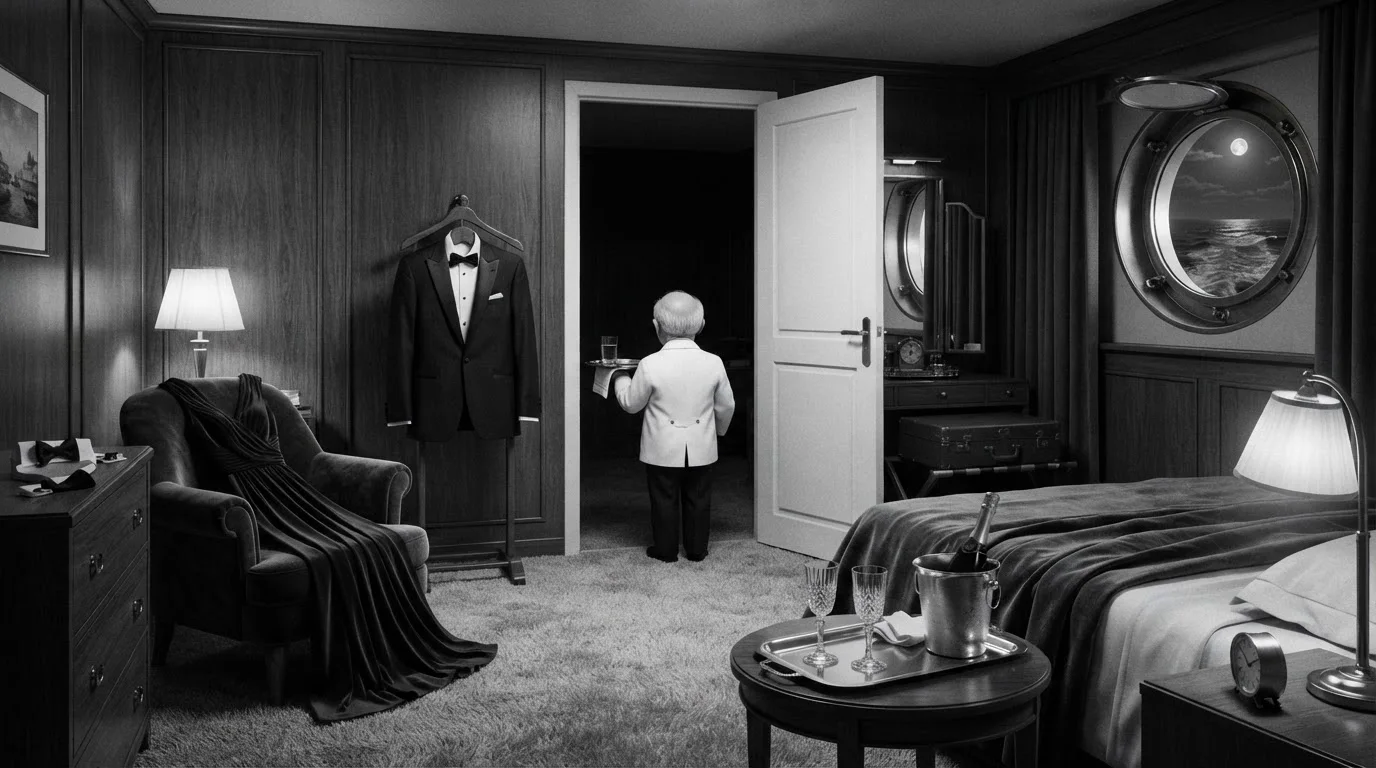
Most of the film takes place in this cabin and a few adjoining rooms. Chaplin uses the cramped space like a stage: when there is a knock, Natascha runs to the bathroom, stewards come in, and while trying to hide one thing Ogden gives away another. The structure rests on the sense of timing Chaplin brought from theater and the music hall tradition. In supporting roles, Sydney Chaplin plays Ogden's friend Harvey, and Patrick Cargill plays the valet Hudson, who is talked into a marriage of convenience with Natascha. Tippi Hedren appears late in the story as Ogden's wife. Margaret Rutherford has a brief but memorable role, and Geraldine Chaplin makes a small appearance.
Brando and Chaplin: Two Different Schools
What happened behind the scenes of A Countess from Hong Kong is talked about as much as the film itself. Chaplin was a director who showed his actors every gesture, every glance and every step by acting it out himself. This habit, formed in the silent years, depended on his building the whole rhythm of a scene in his own head. Marlon Brando, by contrast, was the most famous representative of a generation used to playing a character from the inside, through their own inner process. Bringing these two approaches to acting together in one narrow cabin was not easy; it is widely known that Brando was unhappy with the shoot.
The tension can be felt on screen as well. Brando's Ogden sometimes seems to be fidgeting inside a mold that makes him uncomfortable. Sophia Loren, on the other hand, settles into her role far more easily; Natascha's warmth, her sad past and her playfulness are what really carry the film. She is also the person Chaplin's camera looks at with the most affection.
A Farewell in a Steward's Uniform
Chaplin is not the star of this film. He gives himself only a small part: an elderly steward on the ship, suffering from seasickness. His screen time is no more than a few minutes, yet this brief appearance is one of the film's most touching moments. One of the most recognized faces in the world, in his own last film, is an ordinary attendant standing at a door with a tray, swaying with the waves.
The choice recalls how the Tramp always stood at the edge of the world, as a servant, a waiter, an extra. Instead of a grand farewell speech, Chaplin withdraws from the screen with a brief stagger at a cabin door. It is a modest salute that suits his cinema perfectly.
The presence of two of Chaplin's children in the film turns this farewell into something like a family photograph. Sydney and Geraldine are in the cast, while their father is the old steward at the door. It is as if Chaplin were slowly handing the stage over to others and quietly stepping aside.
The Critics' Coldness, the Song's Triumph
When the film was released, critics were not pleased. Many found it old-fashioned, slow and behind the times. 1967 was a year of new waves in cinema, bold experiments and young directors who defied the rules. In that climate, a film resembling a thirties drawing-room comedy was inevitably seen as an anachronism. Chaplin is said to have been hurt by the reaction.
But one part of the film achieved great success despite the critics' coldness: the song "This Is My Song," which Chaplin composed for it. Recorded by Petula Clark, it reached the top of the charts in Britain, was loved in many countries and was sung by various artists. Chaplin had written the music for his films throughout his life; that the most popular thing to survive from his last film should be a song shows how deep his love of melody ran.
An Old-Fashioned Romantic
Watching A Countess from Hong Kong today, it is possible to see it not by the standards of its time but as an artist's loyalty to himself. Chaplin did not change himself to follow fashion. He believed that love could bloom behind closed doors and amid misunderstandings, and that a man and a woman could find each other despite the barriers of class and the past. That belief had been part of his cinema ever since the flower girl in City Lights.
The love story in the film is an extension of that belief. At first Ogden sees Natascha as a burden that has landed on him; over time he comes to notice her loneliness, her dignity and her zest for life. Chaplin conveys this change not through big scenes but through small glances and brief silences. This way of storytelling, which trusts gestures more than words, shows that even in the middle of the sound era Chaplin remained at heart a silent film director.
Perhaps A Countess from Hong Kong is not a masterpiece. But it paints the portrait of an artist who closed his final curtain not with a fight but with a waltz, and said his last word not with satire but with a love song. Chaplin remained a romantic to the end of his life. The world had changed; he still chose to believe that when the cabin door opened, a small miracle would be waiting inside.