Many people who want to take their first step into silent film get stuck in the same place: "Won't it be old, slow and boring?" Yet when you start with the right film under the right conditions, silent cinema turns out to be the very opposite of what you expect: an extremely lively, fast and universal experience. In this guide we will try to explain how you can watch Chaplin and the films of his era today, what to pay attention to, and which films are a good place to start and in what order.
First, Adjust Your Expectations
Watching a silent film demands a different kind of attention from today's films. There is no dialogue, or it is given through intertitles; the story is told largely through facial expressions, body language, editing and music. This is not a shortcoming but a different language. Give your eyes and ears the first few minutes to get used to it. Putting your phone aside matters especially here: missing a glance or a pause in a silent film means missing far more than missing a line in a talkie.
You also need to let go of a prejudice about tempo. Chaplin's comedies are often surprisingly fast. Chases, falls and misunderstandings follow one another rapidly. The emotional scenes, by contrast, take their time; Chaplin lets the viewer linger on a face. The shift between these two rhythms is the heart of his cinema.
Then there is the matter of acting. Silent-era performances can sometimes look exaggerated to today's eyes: broad gestures, pronounced expressions, long looks. Think of this not as a flaw but as a narrative technique that compensates for the absence of sound. Chaplin is one of the most restrained performers of his era; in his strongest moments he says everything with just a small smile or an ambiguous movement of the cane.
Music, Intertitles and Frame Rate
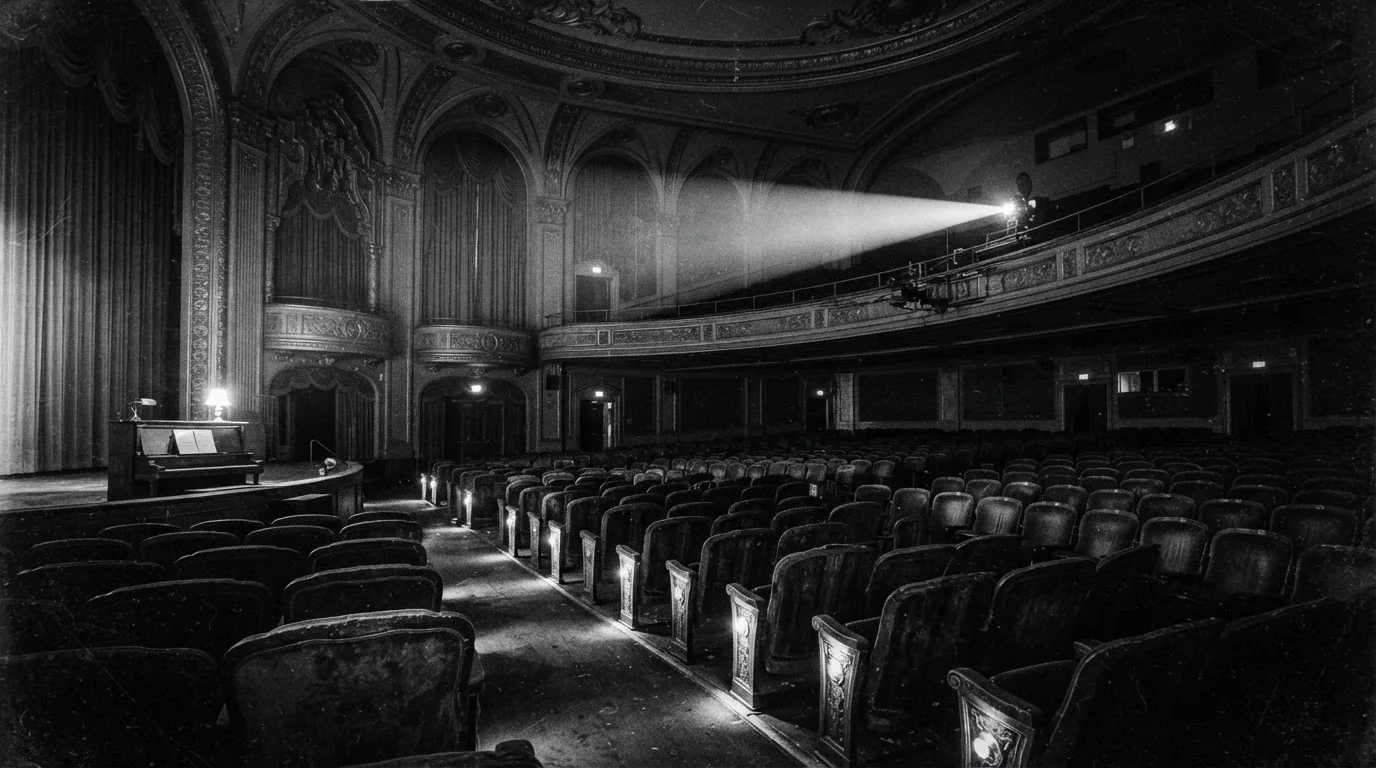
Silent films were never really watched in silence. Screenings were usually accompanied by a pianist, an organ or, in large theatres, an orchestra. The music on the version you watch today largely shapes the experience. With Chaplin we are lucky: in later years he composed his own scores for many of his films and re-released them with that music. Where possible, choose restored versions that use Chaplin's own music.
Intertitles, the title cards that carry dialogue or explanations, stay on screen long enough to be read. If you are watching a subtitled version, make sure the translation of the intertitles is included in the subtitles.
Frame rate is a little-known but important issue. In the silent era, films were often shot not at today's standard of 24 frames per second but at lower and variable speeds. In old copies transferred at the wrong speed, people move in a jerky, comically fast way; the prejudice that silent film is "weirdly fast" comes largely from this. Good restorations correct the problem and movement looks natural. If a film looks too fast and jittery to you, the problem is most likely not the film but the copy.
Aspect ratio should not be overlooked either. Silent films were shot in a nearly square frame. Settings that stretch the image or crop its top and bottom to fill your widescreen TV ruin the composition. Seeing black bars on either side of the screen is normal; Chaplin's framing was designed exactly that way.
Where to Start with Chaplin
Chaplin's filmography is large, and not every film is equally suited as a first step. Our suggestion is to start with the shorts, move on to the features, and save the most moving ones for a little later.
- 1. Shorts: The Immigrant (1917) and Easy Street (1917). At around twenty minutes, these are ideal for getting to know the Tramp and Chaplin's comic rhythm. Because they are short, you can answer the question "is silent film for me?" without any risk.
- 2. A Dog's Life (1918). A slightly longer, more mature short. This is where you begin to see how comedy and tenderness intertwine.
- 3. The Kid (1921). Chaplin's first feature, where the idea of bringing laughter and tears together in one film was born. At around an hour, it is perfect for making the move to features.
- 4. The Gold Rush (1925). The shoe dinner, the dance of the rolls and the cabin on the edge of the cliff. Some of the best-loved scenes in silent comedy are here.
- 5. City Lights (1931). For many, Chaplin's masterpiece. Watched after you have come to know the Tramp through the earlier films, its ending strikes much deeper.
- 6. Modern Times (1936). Machines, the factory and the Depression years. Arguably the farewell of the silent era, and still surprisingly relevant today.
- 7. After that: The Circus, The Great Dictator and Limelight. Once you know Chaplin, you can move on to his more personal, darker or more political sides.
Of course, this is not a rule, just a suggestion. If you do not like a film, there is nothing wrong with leaving it and moving on to the next; every Chaplin film opens a different door, and everyone's favourite door is different.
The logic of this order is simple: first you meet the character, then you form a bond with him, and finally you discover how strong that bond is in the most emotional films.
The Power of Watching Together
Silent comedy was made for crowded theatres from day one. Laughter is contagious, and Chaplin's timing works far better when watched with others. If possible, watch with a friend, with family, and especially with children. Children often take to silent comedy much more easily than adults, because for them there is no language barrier, only movement and feeling. If you hear of a silent film screening with live music in your city, do not miss it; it is the closest you can get to the experience of the era.
Talking for a few minutes after the film ends is also part of the experience. Which scene made you laugh, which one wrenched your heart, which of the Tramp's gestures felt familiar? These questions help you notice how much a silent film actually says. And as you move on to the next film, you will find these small conversations guiding the way.
A Short Checklist
- Choose a restored version transferred at the correct speed.
- Where possible, watch with the score Chaplin composed himself.
- Make sure the intertitles are translated in the subtitles.
- Darken the room and put the phone away.
- Start with the shorts and move to features step by step.
- Do not decide in the first ten minutes; give yourself time to adjust to the language.
- Try watching with others rather than alone.
Silent cinema is not a museum piece but an art that is still breathing. If Chaplin's films can still make people all over the world laugh at the same moment more than a century later, it is because they do not need words. Some evening, dim the lights, turn on the music and see where the Tramp's familiar walk takes you.