 Image generated with AI
Chaplin and His Contemporaries: Keaton, Lloyd, Laurel and Hardy
Chaplin was not alone in the golden age of silent film. In the 1910s and 1920s Hollywood was full of great comedians who found different ways to make audiences laugh. Thinking about them together helps us understand what made Chaplin special.
Buster Keaton: the man who never smiled
Buster Keaton (1895–1966) is known as "the Great Stone Face" because he almost never smiled on screen. Where Chaplin told his emotions with his face, Keaton did the opposite: while the world collapsed around him, his expression did not change. His comedy is more mechanical, built on trains, ships, falling houses and dangerous stunts, most of which he performed himself. The General (1926) and Steamboat Bill, Jr. (1928) are still studied in film schools. The scene in the latter, in which the front of a house falls on him and he survives by standing exactly where an open window passes, is one of the boldest stunts in cinema history.
Harold Lloyd: the bespectacled young man hanging from a clock
Harold Lloyd (1893–1971) is known for his round glasses. His character is neither a tramp nor a stone-faced outsider, but an eager, optimistic, ordinary young man trying to succeed in the city. The scene in Safety Last! (1923) in which he hangs from the hands of a clock on the face of a skyscraper is one of the best-known images of silent film. Knowing that Lloyd shot these scenes after losing two fingers in an accident during a shoot in 1919 makes them even more impressive.
Laurel and Hardy: Chaplin's old companion
Stan Laurel's story with Chaplin began before Hollywood. Both were in Fred Karno's company in England, and Laurel was for a time Chaplin's understudy. In 1910 they sailed to America on the same tour. Years later, Laurel formed one of the world's best-loved comedy double acts with Oliver Hardy. Unlike Chaplin, they had no trouble with the move to sound. Their short film The Music Box (1932) won an Oscar.
So what made Chaplin different?
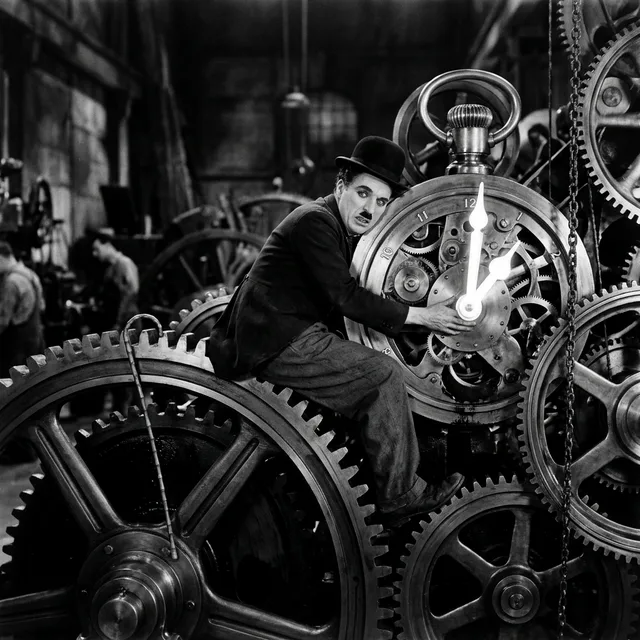
Keaton's flawless mechanical wit, Lloyd's dizzying suspense, Laurel and Hardy's clumsiness built on friendship... All of them were great masters. What set Chaplin apart was the pain he placed inside the comedy. Audiences do not just laugh at the Tramp; they feel for him and hope with him. More than any other filmmaker, Chaplin showed that laughter and tears can live in the same scene.
Where to start?
A good starter list for getting to know these four masters: City Lights from Chaplin, The General from Keaton, Safety Last! from Lloyd and The Music Box from Laurel and Hardy. Four films are enough to show how rich the world of silent comedy was.