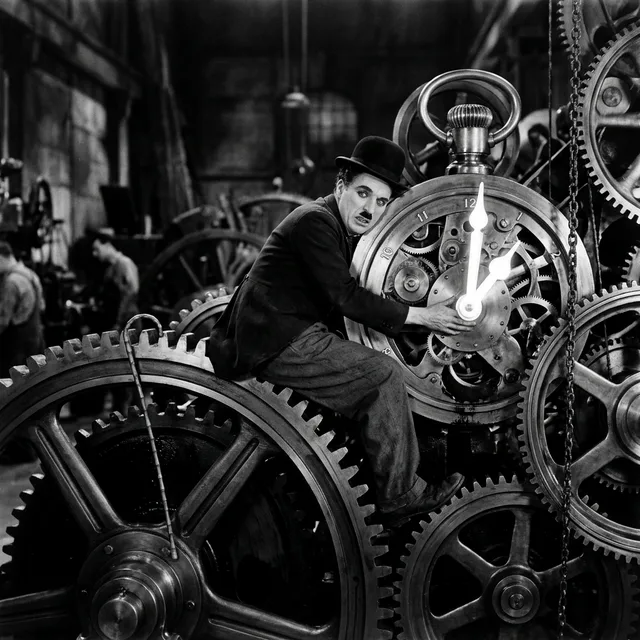
In Modern Times, Charlie Chaplin sharply criticises the effects of mechanisation and the industrial order on the working class. The iconic scene in which the Tramp is caught between gigantic gears is one of the most powerful symbols of humanity's struggle against the machine. Released in 1936, the film remains relevant even today thanks to the deep social messages beneath its humour. It is also the last film in which the Tramp appears on screen, which gives it a distinct air of farewell.
In the shadow of the Great Depression
Modern Times was prepared during the Great Depression that followed the 1929 stock market crash. Millions of people in America were unemployed, and breadlines and strikes had become part of everyday life. After City Lights, Chaplin went on a long world tour, and what he saw on that journey affected him deeply. The economic turmoil in Europe, unemployment and rising political tensions shaped the subject of his next film.
One of the most remembered moments of that tour is Chaplin's meeting with Gandhi in London in 1931. Gandhi's wary stance toward mechanisation led Chaplin to think about whether machines should make human life easier or enslave people. Chaplin also recounted that he had been affected by what he heard about young men being worn down on the assembly lines of Detroit. These observations formed the core idea of the film: a system that turns a human being into a cog.
The Tramp on the assembly line
The film's first section is one of the most recognisable sequences in cinema history. In the opening, an image of a flock of sheep is placed next to a crowd of workers streaming from the subway into a factory. With this comparison Chaplin makes his point clear in the very first seconds. The Tramp is one of the workers tightening bolts nonstop on an assembly line. As the line speeds up his movements grow mechanical; he cannot pause even for a moment, cannot even scratch his nose, because a one-second delay would throw the whole line off.
The factory boss watches all the workers on a screen and even spots the Tramp smoking in the washroom and scolds him. The scene is a surprisingly early depiction of how surveillance settled into modern working life. In another unforgettable episode, an automatic feeding machine designed to eliminate the workers' lunch break is tested on the Tramp. The machine malfunctions, spills soup on his face and spins corn madly in his mouth. It is a ridiculous but chilling parody of a logic that disregards people in the name of efficiency.
In the end the Tramp cannot keep up with the speed of the line and is literally swallowed into the machine. Even while sliding between the giant gears, he keeps tightening bolts. When he comes out he is no longer in control of himself; he tries to tighten everything he sees, buttons, even noses. This breakdown scene is both very funny and deeply unsettling.
A red flag, a prison and a street girl
After the factory, the Tramp's life becomes a chain of misfortunes. When he waves a red warning flag that has fallen off a lorry, trying to return it to the driver, he appears to be leading a marching crowd coming up behind him and is arrested as a communist leader. The scene is a subtle jab at the political paranoia of the time. The irony is that Chaplin himself would face similar accusations in later years.
In prison he accidentally foils a breakout and almost finds himself a comfortable life; compared with the unemployment and hunger outside, his cell feels like a refuge. This reversal is one of the film's bitterest jokes. He then meets a young woman, played by Paulette Goddard, who has lost her father and steals bread out of hunger. For the rest of the film the two walk side by side, two poor people dreaming of a little home.
In the second half of the film the Tramp finds work as a night watchman in a department store. After closing time he lets the young woman in, and for one night the two become the owners of the empty store: they wander through the toy section, sleep in soft beds and eat from the bakery counter. The scene in which the Tramp roller-skates blindfolded along the edge of a floor with no railing is one of the most striking examples of Chaplin's physical mastery. The episode tells, with both joy and sadness, how the poor can touch abundance only behind closed doors, when no one is watching.
The Tramp's first and last song
Modern Times is not in fact a completely silent film. Throughout, we hear music, sound effects and sounds coming from machines or radios, but the characters do not speak. Sound belongs only to authority, to the boss or to the machines. This choice is part of the film's meaning.
Toward the end, a small surprise arrives. Having found work as a waiter in a restaurant, the Tramp is asked to sing a song. The words are written on his cuff, but while dancing the paper flies away. So the Tramp sings with invented words that belong to no language, a mixture of sounds from different tongues, and tells the story with gestures. The audience hears the Tramp's voice for the first and last time, yet there is still not a single meaningful word. Even as he gracefully yields to sound cinema, Chaplin proves once again the supremacy of pantomime.
Even when the Tramp finally lets his voice be heard, he needs no words; the meaning, once again, lives in his body and his face.
The end of the road and its meaning today
In the final scene, the Tramp and the young woman, having lost everything once again, sit by the side of a road. She is about to give up hope. The Tramp signals to her to smile, the two of them stand up and begin walking together down the road stretching to the horizon. This is the Tramp's farewell to the screen. The little man, who in earlier films mostly walked away alone, this time leaves with a companion.
When the film was released it met with hostility in some countries because of its political content, but it drew great interest worldwide. In 1989 it was among the first films selected for the US Library of Congress's National Film Registry. Today its meaning is perhaps broader than ever. Even though warehouses, call centres and algorithms have replaced the factory, people's estrangement from the rhythm of their own labour is still a familiar experience. Wherever work performance is measured second by second and even breaks are counted in efficiency calculations, the Tramp's body sliding between the gears comes back to life.
The strength of Modern Times lies in never turning this critique into a lecture. Chaplin offers no programme and points to no villain. He simply shows how human a little man who cannot keep pace with the system remains. And that humanity, no matter how fast the machines become, is what the film wins back every time we watch it.